Local SEO field guide
How service businesses get found on Google.
A practical system for connecting the work you do, the places you serve, and the proof customers need—without chasing a mythical list of ranking tricks.
What local SEO actually needs to do
A service business does not need traffic from everyone. It needs to appear when a plausible customer has a problem the business solves, in an area the business can serve, at a moment when the customer is ready to compare options or make contact.
That can happen in two related places. Traditional organic results usually point to pages on your website. Local results in Maps are connected to an eligible Google Business Profile. The website and profile should support the same real business, but they are not interchangeable.
Google says local results are mainly based on relevance, distance, and prominence. You can improve relevance and prominence through accurate information, useful pages, reviews, links, and other proof. You cannot optimize away the distance between a searcher and a real business location. See Google’s current local ranking guidance.
Start by mapping services to real customer demand
Before writing pages, list the work that produces revenue. Use the language customers use on calls, estimates, and emails—not only internal industry terms. Then separate broad services from specific problems and high-value jobs.
| Business fact | Customer language | Best destination |
|---|---|---|
| Core offer | roof repair, commercial welding, website redesign | A detailed service page |
| Specific problem | roof leak after storm, broken farm gate | A section, guide, or focused service page |
| Real service area | roofer in Lebanon MO | Business Profile plus a useful local page when justified |
| Decision question | repair or replace, how much does it cost | An article that helps the buyer decide |
| Proof query | projects, reviews, examples | Case study or project gallery |
Give each important intent one primary destination. If the homepage, three service pages, and five city pages all target the same phrase with nearly the same copy, they compete for clarity. A simple map prevents that overlap:
- Homepage: who the business helps and its overall value.
- Service page: one type of work, its process, proof, and next step.
- Location page: what is genuinely different about serving that area.
- Guide: a question that deserves an educational answer.
- Case study: first-hand evidence of work completed.
Search tools can help discover phrases, but sales calls are often the better source of intent. Record the wording prospects use and the questions that delay a decision. Those are the raw materials for useful pages.
Build service pages that can stand on their own
A service page should do more than repeat a keyword and ask for a quote. It should help a visitor determine whether the company is a fit. For most service businesses, that means covering the scope, who it is for, the problems addressed, what the process looks like, what affects price or timing, relevant proof, the actual service area, and a clear next step.
Use one descriptive page title and one clear H1. Add supporting headings that match the decision process. Include original photos, diagrams, screenshots, or project details when they help someone understand the work. Link to the page from navigation, the homepage, a related industry page, or a relevant article so neither customers nor crawlers have to guess it exists.
Google’s people-first content guidance asks whether content provides original information, demonstrates first-hand knowledge, and leaves the reader feeling they learned enough to achieve a goal. That is a better editorial test than a target word count.
A useful service-page outline
- State the service, audience, and area plainly.
- Explain the situations that make the service appropriate.
- Describe what is included—and what is not.
- Show the process from first call through completion.
- Answer real cost, timing, access, or preparation questions.
- Add verifiable proof: projects, credentials, photos, or reviews.
- Offer a specific contact path that matches the service.
For an example of this structure applied to a trade business, see the Cypris Roofing website case study and the roofing website service page.
Create location pages only when the location changes the answer
A real location page may explain travel or response expectations, local permit or climate considerations, projects in that area, a staffed office, service limitations, or a team member who serves the market. Those details help someone make a decision.
Changing a city name in the same template dozens of times does not create local expertise. At scale, pages built mainly to rank for similar searches and funnel visitors to one destination can become doorway abuse under Google’s spam policies. Publish fewer, stronger pages until you have proof and operational detail for more.
A service-area business should also represent its address honestly. Google’s Business Profile guidelines distinguish customer-facing locations from service-area businesses and prohibit virtual offices that are not staffed during business hours. A rented address is not a shortcut to local relevance.
Before publishing a city page, verify:
- The business really serves the area on the terms described.
- The page contains local facts or examples unavailable on other city pages.
- The offer and contact process are accurate for that market.
- The page serves a visitor even if search engines send no traffic.
Treat the Google Business Profile as a maintained business record
Complete the profile with the real business name, the most specific accurate primary category, relevant secondary categories, correct phone and website, current hours, and an honest address or service area. Complete verification when Google requests it. Keep holiday and temporary hours current.
Choose categories for what the business is, not every phrase it hopes to rank for. Link the profile to the most useful canonical page—usually the homepage, or a legitimate location page for a distinct staffed location. Keep the same core identity across the website, profile, major directories, and professional associations.
Add useful photos of the team, vehicles, work, office, or finished projects. Posts and updates can help customers, but they do not replace accurate business information, reviews, or a website that explains the services.
Check the profile monthly and after any business change. Watch for user-suggested edits, duplicate profiles, incorrect categories, and outdated hours. If more than one profile exists, confirm that each represents an eligible, distinct location rather than creating duplicates for search coverage.
Build proof through reviews, projects, citations, and links
Customers and search systems both need independent reasons to believe a business is established. Four types of evidence work together:
- Reviews
- Ask real customers for an honest review after a meaningful point in the job. Make the request easy, respond professionally, and never fabricate, gate, or buy sentiment.
- Project evidence
- Publish the problem, scope, approach, and observable result. If revenue or ranking data is unavailable, say what was built and avoid inventing outcomes.
- Citations
- Keep the business identity accurate on high-value platforms, licensing bodies, trade groups, and local organizations customers actually use.
- Editorial links
- Earn references by doing useful work: original resources, local partnerships, sponsorships with real community value, expert contributions, and newsworthy projects.
Do not treat every directory listing as equally valuable. Prioritize platforms relevant to the industry or market. Avoid paid link schemes, mass guest-post networks, and reciprocal-link programs created mainly to manipulate rankings.
A strong case study can support sales, search, referrals, and outreach at the same time. It is one of the few assets that improves both the website’s information and the reason another organization might mention it.
What documented proof looks like
Our Cypris Roofing case study separates the delivered scope from results we cannot verify. It records website design and development, links to the live build, and shows the homepage and inspection-request path. It does not claim an increase in traffic, rankings, or revenue.
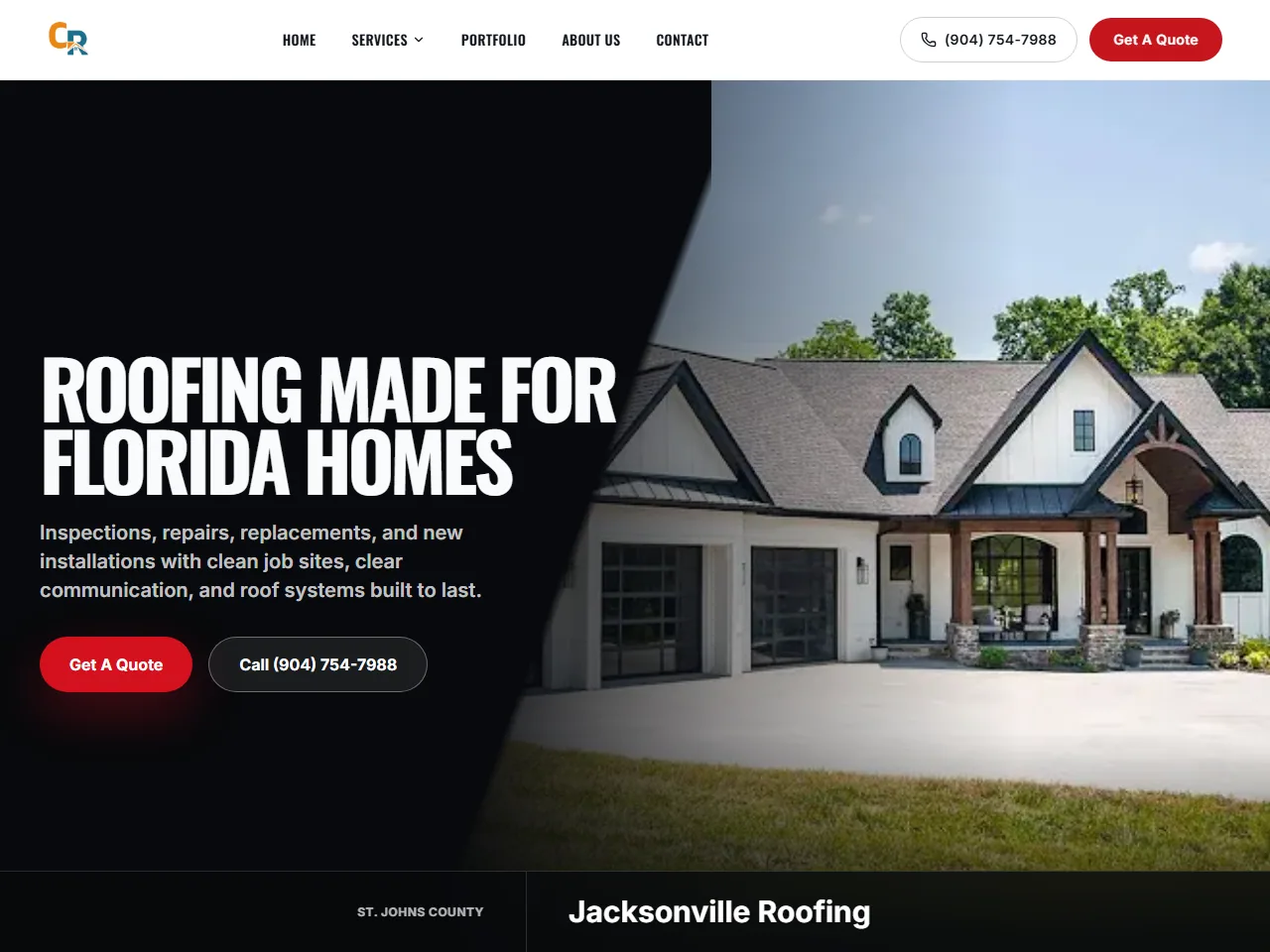
For your own business, publish the work you can substantiate: the customer problem, service performed, real photos, and what changed. Keep measured outcomes separate and include their source and time period when available. A website build example demonstrates our delivery approach; a roofing job example would need to document the roofing work itself.
Keep the technical foundation boring and dependable
Technical SEO should make important pages easy to crawl, index, understand, and use. It should not become an endless exercise in scoring tools. Start with the failures that can prevent discovery or frustrate customers:
- Important pages return a successful status and are not blocked or marked
noindex. - Each page has one preferred URL, a self-referencing canonical, a useful title, and a descriptive meta summary.
- Internal links use real anchor text and point directly to the final URL.
- The XML sitemap contains canonical, indexable pages and is submitted in Search Console.
- Redirects preserve useful old URLs after a redesign; missing pages return a genuine 404.
- Content and contact actions work on a phone, with readable type and accessible controls.
- Images have dimensions, sensible compression, and alternative text when they convey information.
Google’s SEO Starter Guide emphasizes logical organization, descriptive URLs, useful content, and links that help discovery. Search Console’s URL Inspection tool is the first place to diagnose whether Google can access and index a specific page.
Performance matters, but use real measurements
Core Web Vitals currently cover loading with Largest Contentful Paint, responsiveness with Interaction to Next Paint, and visual stability with Cumulative Layout Shift. They are part of a broader page experience, not a substitute for relevance or usefulness. Test representative templates in PageSpeed Insights and use field data when available. Fix the biggest observed issue first. Our Core Web Vitals guide explains that workflow.
Structured data can clarify entities and page types, but it must match visible content and supported Google features. Schema does not turn a weak page into a strong one, and rich results are never guaranteed.
Measure the path from search to qualified work
Rankings are diagnostic, not the final business outcome. A useful measurement chain connects visibility to revenue:
Use Google Search Console for queries, pages, clicks, impressions, and indexing. Use privacy-conscious analytics for landing-page behavior and completed contact events. In a CRM or simple spreadsheet, record whether each inquiry was qualified and whether it became work.
Review page-level trends monthly, but compare meaningful windows. Google notes that some changes can appear quickly while others take several months. Seasonality, brand demand, competition, and your sales process can all change the numbers.
A practical monthly review
- Which non-branded searches produced relevant impressions?
- Which landing pages earned clicks and completed inquiries?
- Were those inquiries in the service area and for profitable work?
- Which pages have impressions but a poor click rate or weak offer?
- Which sales questions are not answered anywhere on the site?
- What new proof can be added from completed work?
If clicks increase but qualified inquiries do not, do not publish more pages automatically. Inspect intent, offer clarity, proof, contact friction, and lead handling first.
A focused first 30 days
Establish the baseline
- Verify Search Console and analytics.
- Record qualified leads by source.
- Inspect the homepage and priority service URLs.
- Audit the Business Profile for accuracy and eligibility.
Clarify page ownership
- Map services, problems, and locations.
- Assign one primary page to each valuable intent.
- Consolidate obvious duplicates only after checking data.
- Fix broken internal links and unwanted redirects.
Improve one money page
- Add scope, process, buyer questions, and a specific CTA.
- Add real project evidence or original imagery.
- Connect the page from relevant navigation and content.
- Test the mobile contact path.
Start the evidence loop
- Request honest reviews from recent customers.
- Publish or improve one case study.
- Correct the highest-value business listings.
- Record changes and schedule a 28-day review.
The next month should be based on what the baseline reveals. Improve pages already earning relevant impressions before multiplying pages. Publish a new guide when it answers a recurring buyer question. Build another location page only when there is real local substance.
Sources and editorial note
This guide was prepared by Tyler Cardwell for owners of service businesses and reviewed against Google Search Central and Google Business Profile documentation on September 30, 2026. It is practical guidance, not a claim to know Google’s private ranking weights. Search products and policies change; the linked primary sources are the authority when guidance differs.